
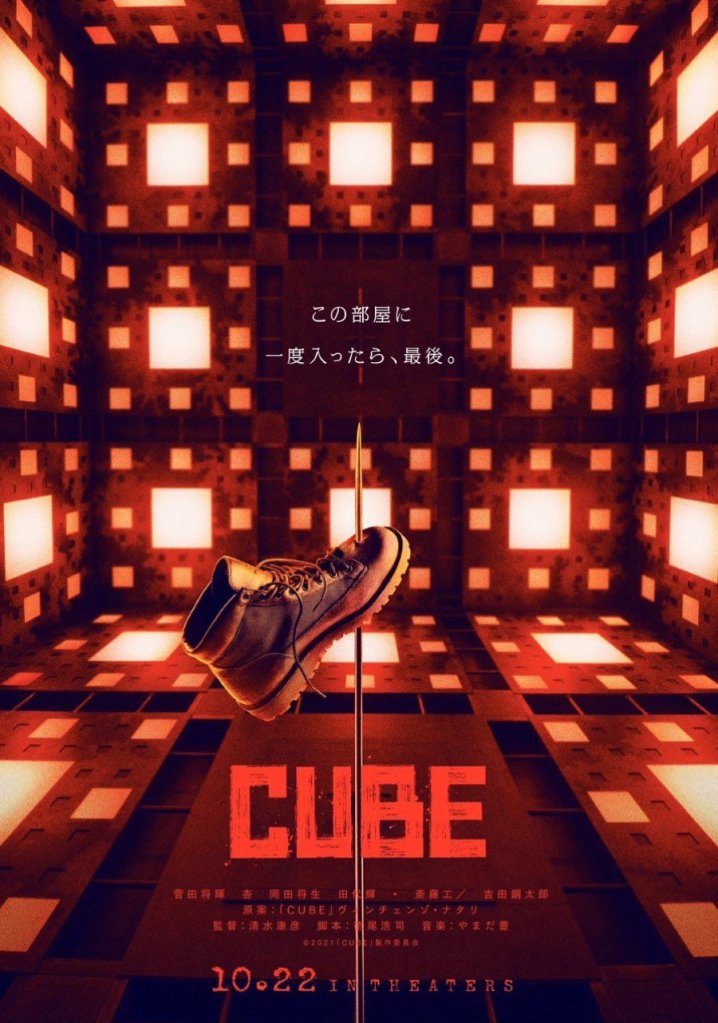
I’m going to try to do another 31 full reviews (as well as my micro-reviews) this October. It was a fun challenge last year, so why not do it again? I’m watching at least 31 new-to-me horror movies and I’ll share what I thought about them here. I’m going to start with the Japanese remake of Cube (1997). I’m not planning to do a theme this year. Just whichever horror movies that I feel like watching. It’s also a good motivation for clearing out queue accumulation. So, let’s get into it, shall we?
Cube opens with a tease of what audiences are to expect with a man getting killed by a trap in one of the cube rooms. From there, we are introduced to 6 other characters who all wake up in the cube with no recollection of how they got there and no idea of what the place is. They soon find out that it is a maze of cube rooms with hatchways on each wall. They don’t know how many rooms there are (or even that it’s a cube) but they soon find out that some of the rooms are booby trapped. If they don’t get out somehow, they will die of thirst. So, they slowly make their way in one direction as much as possible hoping to find an exit. At first, they use boots tossed into the rooms to find/trigger the traps. Then they figure out that each room has unique numerical codes that indicate whether they are safe or not. Tensions rise, mistakes are made, and people die. Will any of them get out safely?
The original Cube is a flawed but clever sci-fi nailbiter. It has some uneven performances and some character arcs that border on caricature. But it is very good nonetheless. One of my bigger gripes with it was carried over into this remake. Namely, the guy who dies in the first few minutes of the film. I fully understand that his role is to simply give us a “holy shit” moment and set the story up with high stakes right from the jump. But why would there be seven people in a cube themed torture/survival experiment? Shouldn’t it be six? (i mean, a cube has 6 sides after all) In the original, we find out that each of the six people have singular talents that contribute to “solving” the cube – the leader, the medic, the one with knowledge of the facility, the escape artist, the one who’s pretty good at math, and the one who is preternaturally good at math. All required for progression through the killer maze. In this one, it’s just a group of people. The story does develop a half-assed olds vs youths dynamic and has some child abuse flashbacks thrown in, but after the badass clever dude is out of the picture, the folks mostly just bumble about. And then the cube does some weird stuff that wasn’t in the original. Like, a wall turning into a screen that shows a cinematic flashback from a character’s life. Or, a non-trapped room suddenly springing a wall up to separate the group in two. The society in microcosm from the original is abandoned here. Instead, we have mostly boring everymans barely driving the story forward (and themselves through the rooms). Maybe it’s a Japanese culture thing that I’m just not picking up on. Certainly the generational conflict is relatively universal. But that doesn’t really seem to be the driving focus of the film. There also seems to be unspoken/unaddressed gender conflicts with the sole woman of the movie (reduced from 2 in the original) staying mostly silent until an eye-roll-worthy reveal at the very end that sort of explains the dead 7th person from the beginning. Some remakes were better left unmade. This is one of them.
The Final Cut: Cube (2021) is a misguided sequel that makes changes to story and characters for the worse. Magical memory projecting tech is just one of its many problems, but it’s a perfect example of the poor storytelling on display.

